

Great Change
“When something bad happens, you have three choices.
You can either let it define you, let it destroy you, or you can let it strengthen you.”
~Dr. Seuss
In Part III, you will recognize concepts discussed in Change Part I and Part II. Here we are going to explore how to apply this information to times of great change.
When the COVID-19 pandemic began, we collectively experienced immense and unimaginable change, overnight. We experienced extraordinary changes in our daily lives. Many worked from home, while others did not work at all. Previously simple, mundane tasks such as going to the grocery store to pick up a few essentials turned into an experience of mass anxiety and panic. Shelves were emptied of basics like rice and toilet paper and fear was painfully visible in everyone’s eyes. Schools across the country closed and suddenly, we were faced with the herculean task of managing our children’s days and maintaining their physical, mental and emotional well-being- in addition to our life and business responsibilities. The constant fear of threat, made it very challenging to maintain any sense of normalcy. We had never lived in a world of such great uncertainty and with such obvious suffering all around us. Our lives were forever changed.
Significant change can severely impact our daily personal and professional lives. Personally, it can affect our daily routines, relationships, family dynamics and more. Professionally, we are seeing and experiencing significant change happening at an unprecedented pace. Externally, we are witnessing the stock market’s vulnerability, unemployment reaching unheard of levels and the negative chatter of news planting the seeds of fear- reminding us of our personal uncertainties and fears. Internally, we are making difficult decisions, while feeling a deep ache in our hearts and spirits as we do what needs to be done for the survival of our families and enterprises.

What can we as individuals learn from great change? How can we apply this to our daily lives? How do we manage the chaos in our personal and business lives? What tools and skills can we build and develop to better prepare for the inevitably unpredictable events in our lives?
You may be feeling overwhelmed by information coming at you from all directions. You may be experiencing deep fear about the present and future. You may feel angry and resentful at change and its disruption to your life and your plans. You may feel saddened by the suffering you are witnessing. When your mind feels turbulent and filled with these emotions, you lose your ability to observe things clearly. Your emotions color and cloud your perspective. If everything seems to be tilting toward negativity, you are most likely seeing yourself and the world through a stormy perspective. In this state, it is important to not jump to conclusions and most importantly to not react. Instead, pause; identify what you are feeling and accept what you are feeling. Then, lean into it, stay with it and observe what surfaces in your mind.
“don’t run away
from heavy emotions
honor the anger;
give pain the space
it needs to breathe
this is how we let go”
~Yung Pueblo
A Meditation: Honoring and Accepting Your Feelings
Find a quiet place to sit and gently close your eyes. Slowly breathe in and out. Once you are calm and fully present, connect with your feelings by asking yourself, “at this moment, what am I feeling deep within?” Start with the strongest feeling, maybe it is fear. Feel the fear…notice where it sits in your body. Now, take a deep breath, move it to where the fear sits, and then slowly exhale the fear. As you release the fear from your lips, you will begin to feel it slowly dissipate. Repeat this several times. Now, notice how the turbulence and the overwhelming emotions have been replaced by a sense of peace and calmness. Observe how your body feels, your sense of well-being, the clarity of your mind and lastly, notice your renewed perspective.
“Life is a series of natural and spontaneous changes. Don’t resist them; that only creates sorrow. Let reality be reality. Let things flow naturally forward in whatever way they like.”
~Lao Tzu
We are living and breathing organisms on a magnificent planet, suspended and rotating in space. The one and only constant in this experience is change. In fact, the only absolute in life is change. Change is happening everywhere, every second. Our most impactful reminder of change is death. Learning how to be aware of and be present with our resistance to change, allows us to accept that change is happening, and allows it to unfold- instead of being blindsided by it.
Acceptance is a critical response to change. Accepting the fact that we are powerless over many events and circumstances that arise in our lives, alleviates a great deal of suffering. When we are presented with change, the one thing that we can control, is how we perceive the external event that is taking place. When we truly understand that, we can quiet our amygdala within our brain (which activates our fight-or-flight response) and move into our frontal lobes, where calm thinking, reasoning, decision-making and planning take place.
Accepting how things are right now does not mean complacency, nor does it imply inaction. Acceptance simply means that we are in the present moment without resistance. This place helps us set aside tension and attachment, so we can take in what is happening and actively respond in our wisdom. In contrast, resignation is simply giving up, ignoring reality and passively withstanding the suffering it brings.
True acceptance creates a state of calmness. This is a powerful state of being. It brings clarity to our vision, enhances our thought process and perhaps most importantly, it radiates outward into the world. A calm person in a chaotic environment has the power to set the tone for all.
“We cannot change anything unless we accept it.”
~C.G. Jung
“The source of all wakefulness, the source of all kindness and compassion, the source of all wisdom, is in each second of time.
Anything that has us looking ahead is missing the point.”
~Pema Chödrön
When we go into the future or into the past, we rob ourselves of the present. The only place we have to work with is right now. We must work with the present situation rather than a hypothetical possibility of what could be or a subjective story from the past. We need to simply be with ourselves and our situation and not get hooked by looking for alternatives. Ultimately, the only thing we have control over in the present moment is how we choose to perceive it.
Being present gives us the opportunity to see things as they truly are and to be relaxed, open, creative and authentic in our communications with others and in our problem solving. Being present simply starts with a breath, our anchor to the present moment.
“Gratitude for the present moment and the fullness of life now is true prosperity.”
~Eckhart Tolle
The greatest tool for getting present to accept change, is gratitude. In gratitude we are able to see things as they are, not as they should be or how we would like them to be. Gratitude requires that we let go of our ideas about the past and the future. It is an unconditional acceptance of what is real in this moment. It is an awakening to the present moment.
In gratitude, we see and understand the abundance around us and approach our life from a place of plenitude, rather than scarcity. Thanks to neuroplasticity, as we practice gratitude daily, we rewire our brain. As a result, when a difficult situation presents itself, we are able to approach it with curiosity and resilience, instead of fear and defeat.
A Meditation: A Daily Gratitude Practice
Find a quiet place to sit. With your eyes open, hold a spot 3 to 5 feet in front of you, and take several slow, deep and gentle breaths to gradually find your natural breath. Feel the rising and falling of each breath. Now pause, and ask, “at this moment, what am I feeling grateful for?” Continue to breathe- softly and gently. Soon, you may notice a thought of gratitude rise…it may be for your family, your friends, your home or your job…whatever it is, just ‘sit with it’. Continue to breathe gently for a minute, being present in the moment and feeling the gratitude.
Now, close your eyes and turn inward. Feel your breath going in and out. Allow yourself to feel truly grateful for each breath. Feel your heart open and fill it with the warmth of gratitude. Now, envision that love flowing from you, to your loved ones, to your community, to your country, to every continent, to every living being, to the water and air on our planet and finally, see that love surrounding our planet. Now, slowly open your eyes and feel the gratitude. All is well.
“The art of life lies in a constant readjustment to our surroundings.”
~Kakuzō Okakura
In times of great change, Eastern philosophy teaches us to be yielding, flexible and resilient. This wisdom celebrates simplicity, patience and compassion as the “three treasures”.
Without simplicity, we may become angry or resentful at change. Even in times of crisis, our basics can be found. Simplicity helps us appreciate what we have. Right now, we can find joy in our family, friends, humor, natural beauty, art, music and knowledge. In simplicity, we find an opportunity for renewal and regeneration, an opportunity to live a life that is simple.
Without patience, we may act rashly- without awareness. Panicked reactions most often make things worse. Patience is rooted in pausing and breathing. It requires courage and perseverance and allows us to endure challenging times, without losing hope.
Without compassion, we can become isolated. In a crisis, there is a propensity to think that it is “every man for himself”. We witnessed this in the pandemic with the mass hoarding of food and supplies. This thinking increases loneliness, conflict and fear. Compassion is the root of human connection. The suffering, the isolated, the depressed and the afraid need us and we need them. Compassion takes us beyond our self and brings us together. As our compassion grows, so do we.
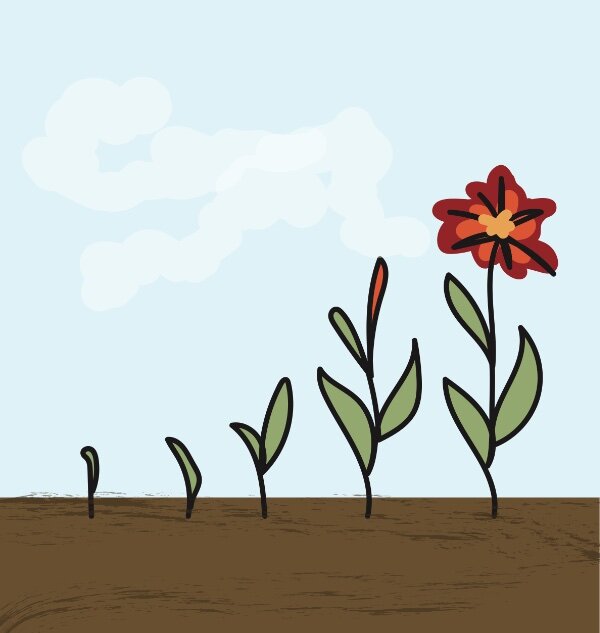
We have become accustomed to a world of immediate gratification– of instant downloads and fast food. Our planet is suffering from human consumption, our social lives have become fragmented, our political life polarized and our physical and mental health continue to suffer greatly. We have been moving at a furious pace in an unbalanced state for too long. Times of great change offer us an opportunity to do things differently, and maybe even better.
Change challenges us and reveals where we have grown and where we need to grow next. Tough moments and how we choose to perceive and respond to these moments, measure the progress of our inner work. If we step back, we give ourselves the opportunity to rediscover our balance, to find joy in simplicity, to practice patience and to engender compassion for ourselves, each other and our planet.
“It is under the greatest adversity that there exists the greatest potential for doing good, both for oneself and others.”
~Dalai Lama
Constancy: Our Anchor During Change
In times of great change, we may lose many of our constants. The ongoing rhythms of our lives may disappear altogether or at the very least, change.
While in a period of great change- no matter how much is going on around us, we can take comfort in the regular pulse of life by developing constants in our daily lives. Through daily commitment and discipline, we can create constants- anchors that give us equilibrium within great uncertainty. These constants help us regain and maintain our balance. To create constants in your life, practice the following every day – once in the morning and once at night:
Morning Anchor:
First thing in the morning, before you reach for your phone or engage with any electronic device, take 1-2 minutes to read a page from a book that is meaningful to you. It is ideal if this book is organized in a daily format. The book we recommend is The Daily Stoic by Ryan Holiday.
Evening Anchor:
Every night before you go to bed, take 2-5 minutes to sit down with your journal to reflect on and answer the following questions:
By practicing these two anchors every day, they become habits. Habits are typically created in response to something causing us discomfort or pain. Here, we are purposefully creating a habit to help us feel better- more calm and stable as we weather change. You will find that what works within your mind- in the confines of your home, works everywhere. Anchors give us constants. They are the bookends of our daily life that give us equilibrium and meaning, and nourish our spirit. Through constancy, we persevere and live a balanced and fulfilling life.
Questions for Self-Exploration
The content, structure and flow of this exercise are designed to guide you in: